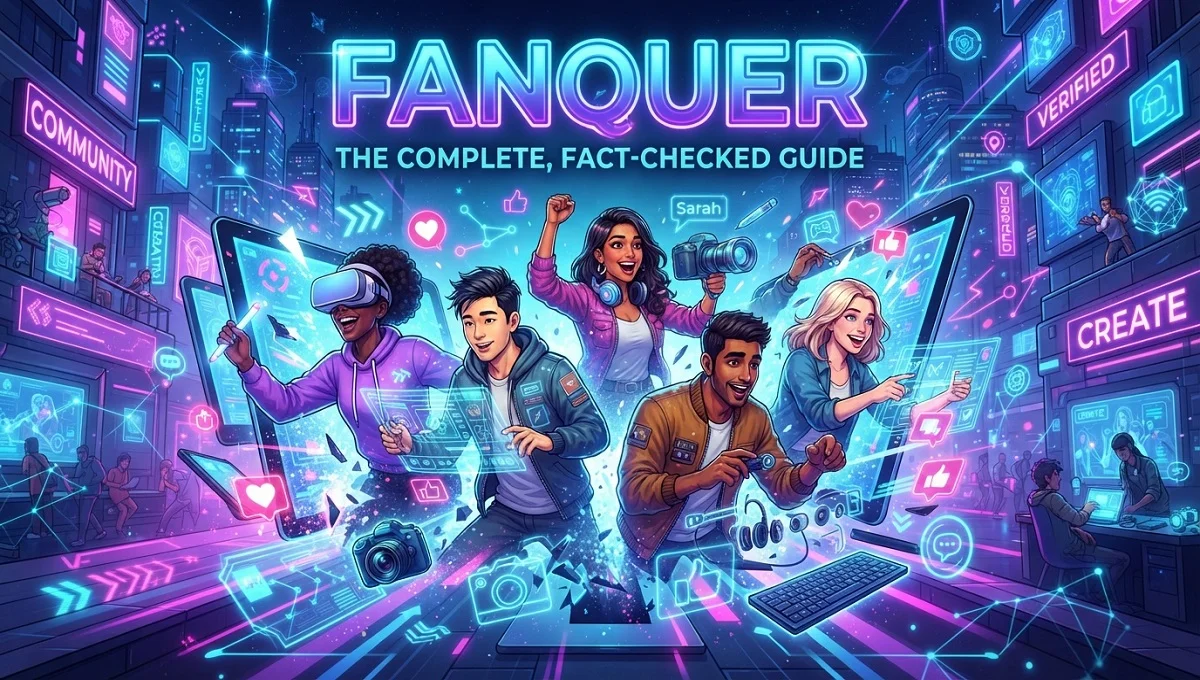
Fanquer: The Complete, Fact-Checked Guide
1. Introduction: Why Fanquer Matters in 2026
Every day a new word is born in the digital world. Few ═ however ═ truly record an authentic evolution in the way we engage with content, brands, and ourselves like Fanquer. If you came across this word on the timeline in social feeds, community Discords or marketing discussions sometime during 2026 —you are not alone. It signifies a transition from passive scrolling to active doing; where fans no longer only consume— but co-create, and dictate (and even take over) the narratives they love.
This guide has been fact-checked against the latest online resources, community discussions and digital trend analyses as of mid-2026. If you’re a creator, marketer, brand manager, or even just someone existing within the web today, understanding Fanquer could be your way of getting ahead at making authentic connections. We will learn what it means, history behind it, its impact and future with applicable Q&A for you to use now.
2. Defining Fanquer: More Than a Buzzword
At its core, Fanquer is a portmanteau blending “fan” with elements suggesting “conquer” or active agency (often stylized playfully). It describes individuals and communities who transcend passive fandom. A Fanquer actively contributes, remixes, influences, and co-owns the brands, creators, or cultural properties they support.
Unlike a casual follower who likes a post, a Fanquer might:
- Vote on story directions or product features.
- Create and share user-generated content (UGC) that becomes canon.
- Participate in community governance via polls or DAOs.
- Remix official content into new art, memes, or extensions.
This isn’t just hype. In 2026, platforms and creators witness superior retention rates and loyalty from fans as they shift toward more participatory models. That is what Fanquer signals: a almost total democratization of influence, the wall between creator and public has become virtually nonexistent.
The Fanquer Manifesto (drawn from emerging community ethos):
- Participate, don’t just observe.
- Prioritize shared ownership over blind loyalty.
- Value raw authenticity over polished perfection.
This definition changes as you use it, allowing flexibility across niches—from games & entertainment to fashion, education, and tech startups.
3. Linguistic Origins and Evolution
Fanquer lacks ancient roots. Around 2024, organically in decentralized spaces (private Discords, niche forums and early Web3 communities). The originally tongue-in-cheek moniker for ultra engaged fans, which “drove the roadmap”, became firmly established by 2025 when generative AI hit mainstream and regular enthusiasts began creating quality content.
It reached 2026 through social search, meme culture, and branding experiments. Many assert that playful influences echo with there being words like “flâneur” (the urban observer), but Fanquer takes a step away from mere passive surveillance and instead embraces the role of conqueror.
Evolution Timeline (approximate, based on observed trends):
- Pre-2024: Passive “fans” and “followers.”
- 2024: Early co-creation experiments in indie projects.
- 2025: AI tools lower barriers; communities formalize participation.
- 2026: Mainstream adoption in marketing, with dedicated guides and tools.
This evolution closely parallels the shift on the wider internet, from Web 1.0 (read-only) through to Web 2.0 (read-write) to today with participatory ecosystems.
4. The Core Pillars of Fanquer Culture
Fanquer rests on three foundational pillars that explain its appeal and staying power.
Hyper-Contextual Connection Communities create deep, internal ecosystems with common shared references. Across an individual scene in a show grows its sub-languages, lore, and world-building so dense that it becomes almost impenetrable to outsiders. This creates tight-knit belonging.
2. Anti-Polish Authenticity In an AI-perfected world of filters and polish, Fanquers celebrate the glitchy, raw, and human. Imperfect user videos or unscripted threads often outperform glossy campaigns. Authenticity builds trust.
3. Collective Intelligence Fanquer groups function like superorganisms. Trends are dissected, memed, and iterated in real-time—faster than traditional media. This swarm intelligence drives innovation and rapid feedback loops.
These pillars make Fanquer resilient and adaptive across platforms.
5. Fanquer vs. Traditional Fandom: Key Differences
Traditional fandom is top-down: creators release, fans consume, buy merch, and attend events. Loyalty is expressed through consumption.
Fanquer is horizontal and collaborative:
- Control: Fans influence direction via votes or contributions.
- Output: UGC can become official or rival it in reach.
- Metrics: Success measured by participation depth, not just views or likes.
- Relationship: Co-ownership vs. admiration from afar.
| Aspect | Traditional Fandom | Fanquer Culture |
|---|---|---|
| Role of Fan | Consumer/Supporter | Co-Creator/Stakeholder |
| Content Flow | Top-down | Bidirectional/Collaborative |
| Engagement Depth | Likes, comments, purchases | Governance, remixing, ownership |
| Longevity | Tied to releases | Sustained by community |
This shift empowers fans but challenges creators to relinquish some control.
6. The Rise of Fanquer in 2026: Cultural and Technological Drivers
Several forces converged in 2026:
- Loneliness Epidemic Response: Post-pandemic desire for belonging fuels participatory communities.
- AI Democratization: Tools let fans produce pro-level content instantly.
- Social Search Shift: People turn to trusted communities over algorithms for recommendations.
- Short-Form Burnout: Demand grows for deeper, story-built experiences.
- Economic Factors: Creators seek sustainable models beyond ad revenue; Fanquer drives loyalty and direct support.
Platforms emphasizing interactivity (polls, collaborative editing, token-gated access) see stronger growth.
7. Impact on Digital Marketing and Content Creation
For brands and creators, Fanquer transforms strategy from “funnels” to “flywheels.”
Key Strategies:
- Invite participation early (e.g., beta testing, idea submissions).
- Prioritize UGC in campaigns—70%+ of consumers in surveys prefer it for decisions.
- Use DMs and private spaces for deeper relationships.
- Shift metrics: Track contribution volume and sentiment alongside vanity stats.
Examples in Practice:
- Gaming studios letting players vote on updates.
- Fashion brands turning customer designs into limited drops.
- Educators co-creating curricula with students.
Risks include losing narrative control, but rewards are authentic advocacy and organic growth.
8. Psychological Appeal: Why Humans Crave Fanquer Experiences
Fanquer satisfies core needs (drawing from self-determination theory and community psychology):
- Agency: Feeling your input shapes outcomes.
- Relatedness/Tribalism: Deep belonging in niche groups.
- Competence/Creation: Humans love making and sharing.
In automated times, participating affirms humanity. It combats passive doom-scrolling with purposeful engagement.
9. Real-World Examples and Case Studies
- Indie Creators: YouTubers or Twitch streamers running “community canon” votes that fans expand.
- Brands: Companies hosting fan challenges where winners’ ideas launch products.
- Communities: Discords or forums where members govern rules and events.
- Emerging Platforms: Tools built around contribution loops and recognition systems.
These cases show measurable lifts in engagement and retention.
10. Challenges and Criticisms of the Fanquer Movement
No trend is flawless:
- Toxicity and Rage: Heated discourse for visibility can alienate.
- Gatekeeping: Hyper-specific culture excludes newcomers.
- Intellectual Property Issues: Who owns fan creations that go viral?
- Burnout: Constant participation demands time and emotional energy.
- Manipulation Risks: Brands faking authenticity or exploiting free labor.
Addressing these requires clear guidelines, moderation, and inclusive onboarding.
11. The Future of Fanquer: Trends and Predictions
Looking ahead to 2027+:
- Integration with AR/VR for immersive co-creation.
- AI co-pilots summarizing community input for creators.
- Hybrid physical-digital rituals and events.
- Greater focus on ethical governance and ownership models.
- Expansion beyond entertainment into education, work, and civic engagement.
Fanquer could become as foundational as “meme” or “viral.”
12. FAQs About Fanquer
What does Fanquer mean? Active, participatory fandom involving co-creation and influence.
Is it just slang? It started that way but evolved into a practical engagement model.
Who can use it? Anyone—creators, brands, communities, educators.
Is there a Fanquer platform? No single one; it’s a mindset applicable across tools.
Will it last? Likely, as it addresses deep human needs in digital life.
13. Conclusion: Embracing the Fanquer Era
Fanquer is no flash in the pan, it speaks of humankind adapting technology to make meaning and find agency, connection and creativity. And those who get it and go with it will do just fine — in deeper, stronger spaces online in 2026 or whenever.
So, no matter if you’re building a community, promoting a product or just consuming content — be a Fanquer: engage authentically, contribute meaningfully and connect. The Future Is for Those Who Co-Create it.